Three Barriers That No Longer Exist

A few months ago I watched a video. A Microsoft 365 administrator running his entire infrastructure by voice. No clicks. No forms. He talks, and the system does what he says. Create users, manage groups, set permissions, generate reports. Everything.
I thought: I want that too.
Then I understood MCP: Model Context Protocol. The concept is simple: you give an AI access to a system and it operates it. Not one system. Every system. Moodle, SharePoint, email, Docker, WordPress, calendar, databases. You build an interface, and the AI knows what to do with it.
From that moment, something shifted. Not incrementally. Not evolutionarily. Fundamentally.
Since then, colleagues have been asking me: Can it do images? Can it do audio? Can it do spreadsheets, forms, websites, interactive exercises?
The questions are almost endearing. Because the honest answer is: it really can do everything. The question "Can AI also do X?" is the wrong question. The right question is what we do with it.
I started building my own infrastructure. In February I described how the tech works. Today is about what it means. Because along the way, I ran into three barriers I thought were immovable, and suddenly they were gone.
Barrier I: Knowledge
Every morning I walk through the school building. The copiers are running. Stacks of worksheets. Teachers already fixing paper jams at 7:15 AM because the next class is coming and the materials need to be ready. The sound of copiers is the heartbeat of this school. Every morning. For years.
I'm the IT admin. I see the systems we have: Moodle is ready, SharePoint is configured, everything licensed, everything paid for. What gets used is the copier. Not because the staff are stupid, but because the system never learned to work differently. And because nobody asks the admin what might be possible. For most people, I'm the guy who fixes the Wi-Fi.
What's on those copied sheets: procurement cost calculations. Business letters per DIN 5008. Bid comparisons. Customs forms. These are the exam topics for Kaufleute (commercial apprentices, Germany's most common vocational track). It's in the curriculum framework. It's what the IHK (Chamber of Commerce) tests.
And here's where it gets uncomfortable.
The Institute for Employment Research (IAB) in Nuremberg calculates annually how many tasks in each occupation can be replaced by technology. In 2024 they updated their figures: the biggest jump in the history of their methodology, triggered by generative AI. The results:
78 to 82 percent of wholesale and foreign trade clerks' tasks are substitutable. For office management clerks, the figure is over 80 percent. Not someday. Today.
At the same time, over 72,000 new apprenticeship contracts per year are signed in Germany for office management clerks alone. It's the most popular apprenticeship in the country.
The World Economic Forum summed it up in its Future of Jobs Report 2025: commercial-administrative occupations are the world's fastest-shrinking job category.
And Hamburg? Hamburg is a trading city. Port, logistics, wholesale and foreign trade: a disproportionate share of commercial jobs compared to the national average. What's a trend nationally is a slow-motion earthquake here. The Chamber of Commerce puts it cautiously: "Job profiles are changing fundamentally." More honestly: four out of five tasks we test can already be done by a machine today.
We're not preparing them for the wrong future. We're preparing them for the wrong present.
And yes, it's true that not everything will disappear. What remains will even become more important: relationship management, ethical judgment, process orchestration. The problem is: none of that is in the exam regulations. The apprenticeship trains the old-style clerk: filling out forms, formatting letters, calculating by hand. The new clerk (who steers AI-driven processes, interprets data, cultivates relationships) has to figure that out on their own.
But if knowledge is no longer a barrier, if you don't have to study for years to build something complex, what happens to the relationship between a single person and an institution?
Barrier II: Scale
In the last two months I've built 13 interactive learning modules. React applications with drag-and-drop, gamification, progress tracking. Some in up to 13 languages. Plus Moodle courses with exercises, quizzes, certificates. 18 services on one server. One person. On the side, because my actual job is fixing the Wi-Fi.
To put those numbers in context:
The Chapman Alliance, an industry body for learning technology, estimates the development effort for one hour of interactive e-learning at 184 working hours. That's the industry standard. Without AI.
A single online course on Coursera or edX: 6 to 12 months of development, a team of 5 to 15 people, a budget between $50,000 and $250,000.
Germany's largest OER initiative, ORCA.nrw, with dozens of participating universities and hundreds of contributors, produced around 200 modules in three years.
What was built here in two months would have required, by institutional standards: 3 to 5 instructional designers, 2 to 3 frontend developers, 1 to 2 localization specialists. 12 to 18 months. A six-figure budget.
Not because institutions are incompetent. But because institutions have to coordinate. Meetings, approvals, procurement processes, committee sessions, minutes. The bottleneck was never expertise. It was overhead.
A study by Harvard Business School and BCG (2023, 758 management consultants) confirms the effect quantitatively: with AI, participants worked 25 percent faster and delivered 40 percent higher quality. The most interesting finding: the biggest gains weren't among the top performers, but among those who had been furthest behind. AI as an equalizer, not just an accelerator.
AI doesn't eliminate teams. AI eliminates the distance between vision and execution.
If you have an idea (a learning module, a course, a tool), you no longer need to assemble a project team, write a proposal, wait for approval. You build it. Over a weekend. And if it doesn't work, you build it differently the next weekend.
One example: my n8n learning module. Six levels on workflow automation. Two tracks: Ada for businesses, Alan for educators. Same code, different contextual examples. At the end of each track: a Moodle deep-dive course with 24 exercises, a quiz, and a certificate. Free to access. Open source. Built in one week.
Knowledge is no longer a barrier. Scale is no longer a barrier. That leaves the third, and it's the hardest, because we can't see it.
Barrier III: Thought
The first two barriers can be measured. Substitutability rates, person-months, benchmarks. The third barrier has no number. It's the one we've grown so accustomed to that we no longer notice it:
We only attempt things we believe are meant for us.
The psychologist Barbara Oakley calls it the Einstellung effect: once you've solved a problem one way, you stop seeing other approaches. Not out of laziness, out of habit. Daniel Kahneman wrote an entire book about the systematic cognitive biases that limit us: availability heuristic, anchoring, confirmation bias. These aren't weaknesses. They're biological limits on cognitive bandwidth.
AI doesn't share those limits.
The philosopher Andy Clark argued in 1998, together with David Chalmers, in a now-famous paper: cognition doesn't end at the skull. If you think with a notebook, your thinking includes the notebook. If you calculate with a spreadsheet, your calculating includes the spreadsheet. Our minds were never confined to the brain; they were always a hybrid of biology and tools.
AI is the most radical extension of that principle. A thinking partner with no domain boundaries.
Concretely, five barriers I thought were immovable:
The domain. I'm a mathematician and programmer, 17 years self-employed in practice. Not a pedagogue, not an instructional designer. Yet I build complete learning systems: didactically structured, gamified, with certificates. Not because I suddenly studied education science, but because AI opens the search space where good pedagogy and good code converge.
Language. I speak German and English. My math portal has 13 languages. Arabic, Ukrainian, Spanish, Turkish: languages I can't even read. For students learning German as a second language (DaZ) who need to grasp mathematics in their first language before they can practice it in German.
Scale. One person, one worksheet: that was the maximum. Now: 13 modules, thousands of exercises, a portal.
Imagination. I design what I know, and AI shows me solution spaces that lie outside my patterns. When Google DeepMind solved the protein folding problem in 2020, the one biologists had failed at for 50 years, the reason wasn't that the AI was smarter. It was that it could traverse a search space no human brain can hold all at once. Nobel Prize 2024. Same principle, smaller scale: a math teacher builds exercises in 13 languages with AI, and for the first time understands how DaZ learners parse word problems. Not because the AI taught her something, but because the doing itself shifted the horizon.
Self-belief. "That's not my area." That sentence has killed more ideas than any budget. AI turns "Can I do this?" into the question "Should I do this?", and that's a fundamentally different starting point.
AI doesn't replace human thought. AI lets humans transcend their own thinking.
The limit was never intelligence. It was bandwidth, domain boundaries, and the habit of only attempting what you already know how to do. In Vygotsky's terms: AI is the scaffolding that enables action in the zone that was unreachable alone. Not temporarily, but permanently.
A few weeks ago I wrote about post-work: about what happens when machines take over the work. The third barrier shows the other side: it's not just about what machines do for us. It's about what they do with us: with our thinking, our limits, our self-image.
And if a single person, freed from these three barriers, can produce this much, how does it organize itself? Who coordinates it?
The answer is: nobody. And that's exactly the point.
The Synthesis: Stigmergic Production
Earlier this year I wrote about stigmergy: the principle by which ants build complex structures without a leader. Not through communication, not through planning, but through traces. One ant lays a pheromone trail. The next follows it, reinforces it. No plan, no meeting, no project proposal. Just traces that trigger more traces.
The entomologist Pierre-Paul Grassé described this in 1959. The computer scientist Francis Heylighen generalized it to human collaboration in 2016: Wikipedia works stigmergically. Open source works stigmergically. Someone leaves a trace (an article, a code commit, a tool), and others build on it. Without central coordination.
Classical stigmergy requires many agents making small contributions. Thousands of Wikipedia editors, each adding a few lines. The intelligence emerges in the aggregate.
AI changes that equation.
A single person, amplified by AI, leaves traces of a complexity that previously required institutions. Not a few lines of code, but an entire learning portal. Not one worksheet, but 13 interactive modules in 13 languages. Freely accessible, reachable by URL, usable by anyone, extensible by anyone.
This isn't industrial production: not hierarchical, not centrally controlled. Nor is it a pure commons model: not distributed across thousands of small contributions. It's something new:
Hyper-individual commons production. Individuals acting autonomously, amplified by AI, leaving traces that others build on, without anyone coordinating.
The economist Yochai Benkler named what Wikipedia and Linux produced in 2006 "commons-based peer production": production beyond markets and firms. AI supercharges that model. What Benkler's model still required thousands of volunteers for, a single person can now do.
André Gorz wrote in 1999 that the exit from capitalism had already begun: in autonomous activity that arises not from the compulsion to earn a wage, but from the desire to contribute something. Building learning modules that nobody commissioned, that are freely accessible, that anyone can use: that's Gorz's vision, technically realized. Not in some distant utopia, but on a Hetzner server in Falkenstein.
What Gets Lost
Anyone who goes this far has to say what gets lost. And something does get lost.
Quality vs. speed. Institutional teams do needs analyses, accessibility audits, peer review, iterative testing with focus groups. I do: build, test, improve, next iteration. It's faster. Whether it's better, the students will decide that, not me.
Diversity of perspectives. Ethan Mollick, AI researcher at the Wharton School, warns of "AI monoculture": when everyone works with the same tools, the output converges. A faculty brings 80 different perspectives. One person, even AI-augmented, has a cognitive fingerprint. It gets amplified, not dissolved.
Maintainability. Building 13 modules is one thing. Keeping 13 modules current as curricula change, frameworks age, and dependencies break: that's another. Institutions have succession plans. I have a server and a good backup.
These objections are real. But they have a blind spot.
Clayton Christensen's theory of disruptive innovation explains it: what's emerging here may be 80 percent as polished as institutional output, but it's 50 times faster and costs nothing. For most learners, "good enough, now" beats the promise of "perfect, in 18 months".
In my field study of the teachers' lounge I described how the system values thoroughness over effectiveness. The counterarguments hit the same nerve. The right question isn't "Is it good enough?"
The right question is: For whom does it arrive too late?
Start
The copier is still running. 7:15 AM, paper jam, next class incoming. That hasn't changed.
What has changed is me. And a server. And an AI that doesn't share my limits.
13 modules are online. Free to access. No account, no tracking, no fine print. Not because I want to make money from it, but because someone has to start laying traces.
The tools are here. The barriers are gone.
What's missing is people who start.
Start. Now.
Dirk Schulenburg, Hamburg. IT admin. On the side.
Related Articles

Die Schulzentrale kündigt TaskCards. Ich baue in fünf Tagen eine barrierefreie, self-hostbare Alternative, zeige sie, und sie nehmen trotzdem das Original. Über den Macher-Reflex, seine Grenze und eine Schranke, die gerade verschwindet.
September 7, 2026
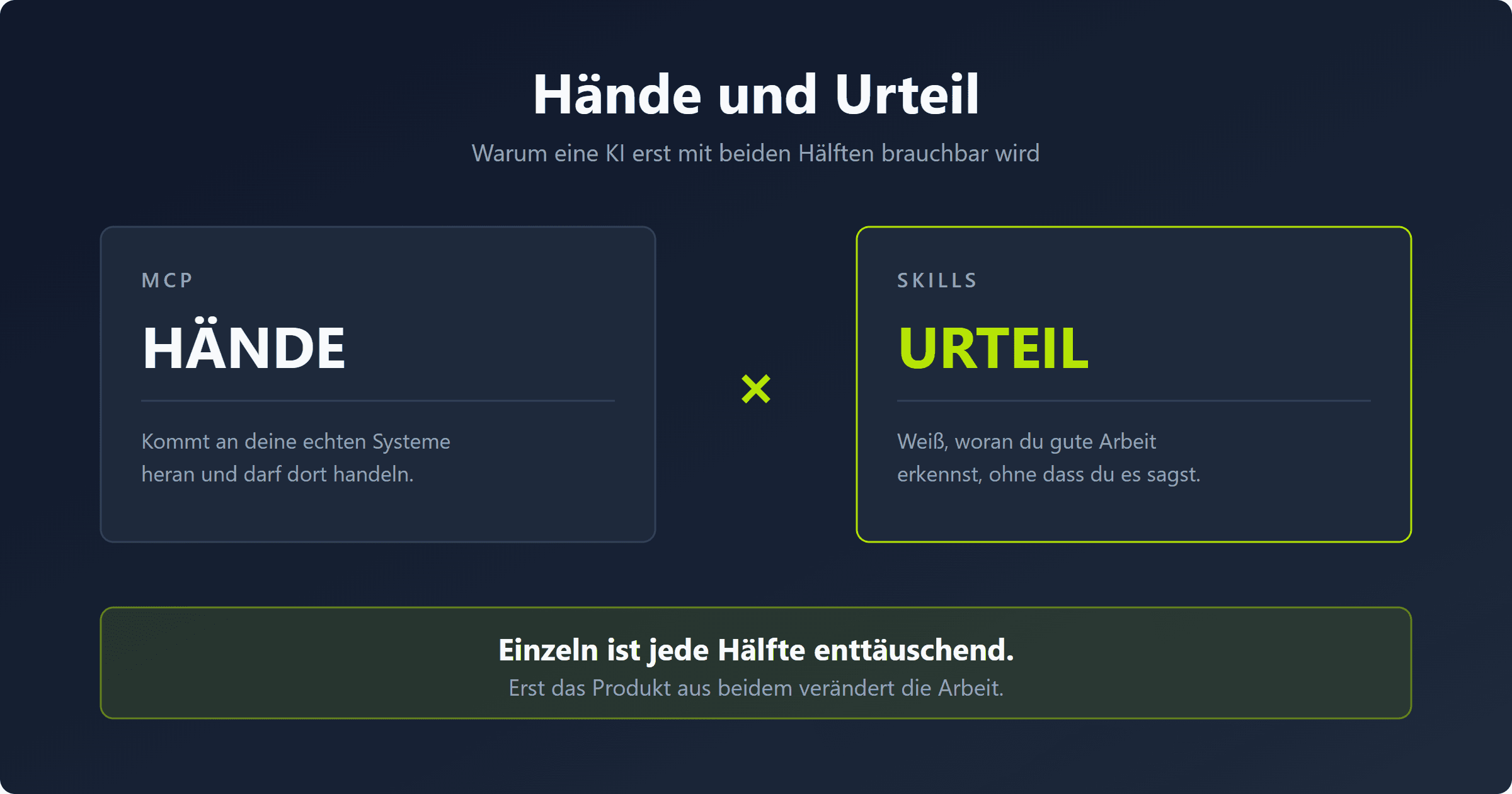
MCP gives an AI hands. Skills give it judgement. Why only the combination is worth anything, how my setup is built from both, and ten practices that work even if you never run a single server.

May 10, 2026
Drei Tage Reflexion über das, was zwischen mir und meinem KI-Setup tatsächlich passiert. Vom Wald in Mitteleuropa über Mykorrhiza-Netzwerke zu MCPs und Skills: warum mein Setup Waldboden ist, nicht Saatgut.
Comments
Comments run on GitHub Discussions (Giscus). The script is only fetched from GitHub once you load it; your IP address is then transmitted to GitHub in the USA. Details in the privacy policy