After Work: Finally Time to Think

Imagine you’re sitting on a bench. Coffee in hand. Sun on your face. Nowhere you need to be. Nothing you need to submit. No Outlook, no stand-up, no quarterly review.
And instead of panicking, you think: Hm. Now what?
Welcome to the post-work world. It’s closer than you think. And it is, here’s the punchline nobody tells you, pretty great. If you let yourself go there.
First, Take a Breath
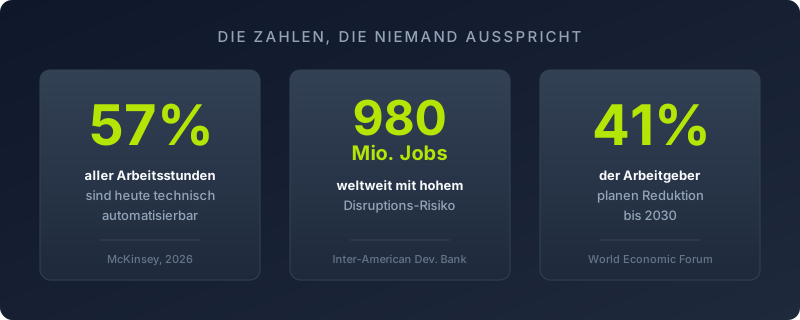
Everyone’s losing their minds. McKinsey says 57% of all work hours are automatable. The World Economic Forum warns of 980 million jobs at risk. Morgan Stanley recommends retraining for “jobs that don’t exist yet”, which is about as helpful as the advice to start packing for a planet we haven’t discovered yet.
41% of all employers plan to reduce their workforce by 2030. Daron Acemoglu, Nobel laureate at MIT, calls human expertise “potentially superfluous.” Superfluous. Nice word.
And what do we do? We debate upskilling programs and bootcamps. A billion-dollar market built on the illusion that we can outswim the tsunami if we just paddle fast enough.
May I make a counter-proposal?
Feet up. Get coffee. Think.
Because the exciting question isn’t “How do I save my job?” The exciting question is: What do I do with my life once I finally get it back?
The Funny Thing About the Panic
I automated my own job. 80%, to be precise. 12 servers, 73 tools, a Hetzner box for 30 euros a month. What used to cost me half a day (Moodle courses, quizzes, worksheets) now takes three minutes.
And the funny part: It was liberating. Not threatening.
Because the 80% the machine now handles were the most boring 80% of my life. Filling out forms. Clicking questions into Moodle fields. Formatting PDFs. Good grief. That wasn’t work, that was a crime against my lifespan.
What remains are the 5% I took the job for in the first place: talking to students. Explaining things that make eyes light up. Listening to someone who’s having a bad day.
Funny. The machine didn’t take my profession away. It gave it back.
A Brief Moment of Honesty
Before we go further: Can we be honest for a second?
David Graeber (anthropologist, anarchist, gone far too soon) wrote in 2018 what we all secretly know: A huge chunk of our jobs is completely pointless.
He called them “Bullshit Jobs.” Financial consulting. HR. PR. Corporate law. Telemarketing. Entire industries whose sole purpose is to manage other industries that in turn manage other industries. An endless matryoshka of bureaucracy.
Keynes predicted in 1930 that by the year 2000, thanks to technology, we’d be working just 15 hours a week. It’s 2026. We work more. And a large share of that extra work is, sorry, complete nonsense.
If an AI takes over these jobs: Who exactly is going to miss them?
Hand on heart: If you found out tomorrow that your quarterly report will henceforth be written by an algorithm, would you cry or secretly dance?
Exactly.
The real problem is a different one. And it’s much more interesting.
We Turned Work into Religion
39% of Americans say their job is central to their identity. “What do you do?” is the first question at every party, every date, every bit of small talk. Not: Who are you? What do you love? What makes you happy? No: What. Do. You. Do.
At some point (creeping, over generations) work took over the role that religion, community, and family once held. Structure. Status. Belonging. Meaning. The job as temple. The salary as blessing. The promotion as enlightenment.
And now a machine comes along and tears the temple down.
That’s the real crisis. Not unemployment. Identity loss. Who am I if I don’t work? What am I worth if nobody pays me?
Hard questions. But, and this is the point I’m building toward, also fantastic questions. Questions we haven’t asked since industrialization because we were too busy being busy.
Finally, we have time to think about them.
So let’s think.
Ten People Who Already Did the Thinking
Turns out: While we were sitting in meetings, some pretty sharp minds were formulating pretty good answers. Some for over a hundred years. Here are my favorites, sorted by increasing degree of radicality.
Gorz: The Multi-Activity Society
André Gorz kicked off the post-work debate in 1980. In “Farewell to the Working Class”, a title that sounds considerably more prophetic now than it did then.
Gorz distinguishes between heteronomous work (externally directed, subject to the market, mostly dull) and autonomous activity (self-directed, meaningful, the stuff you do when nobody’s paying you).
His diagnosis: Meaningful wage labor for everyone is “ontologically unrealizable” in complex societies. Somebody has to maintain the sewers. And no matter how much purpose you read into it, it’s still sewers.
His solution: A multi-activity society. People don’t live for work but within diverse activities: art, community, care, learning, craftsmanship, politics. The leisure created by automation doesn’t flow into new bullshit jobs but into an expanded “autonomous sphere.”
Work less. Live more. Gorz wrote this before the internet existed. The man sat on a bench with coffee and thought. It was worth it.
Srnicek & Williams: Four Demands
Nick Srnicek and Alex Williams, 2015, “Inventing the Future.” Four demands, nice and tidy:
- Full automation of the economy
- Reduction of working hours to the minimum
- Universal basic income for all
- Dismantling the work ethic as a cultural value
Point 4 is the key. It’s not work that needs to change. It’s the valuation of work that needs to change. As long as “What do you do?” remains the first question, we’re stuck in the trap.
My objection: Srnicek and Williams remain fixated on the state. Their UBI comes from the state. Their regulation comes from the state. And whoever gives the state the power to distribute abundance also gives it the power to withhold it. But as a checklist for thinking on the bench? Quite useful.
Bastani: Luxury Communism (Yes, Really)
Aaron Bastani, 2019: “Fully Automated Luxury Communism.” Yes, it’s really called that. Yes, it’s meant seriously.
The thesis: Technological abundance (solar, synthetic biology, asteroid mining) makes capitalism obsolete. In a world without scarcity, we don’t need a market. Bring on the luxury for everyone.
Beautiful. Inspiring. Unbeatable as a party name.
But Mark Featherstone from Theory, Culture & Society hits the sore spot: Bastani has “no theory of power.” He explains what could come, but not how we get there. And ecologically, “automated abundance” is about as sustainable as “all-inclusive cruise for eight billion.”
Bastani is the motivational speaker of the post-work movement. Good for the feels. Bad as strategy.
Varoufakis: Spoiler, The Dystopia Is Already Here
While Bastani dreams of luxury, Yanis Varoufakis shows what’s actually happening: Techno-Feudalism.
His thesis: Capitalism is already dead. Not because we transcended it, but because something worse moved in. The platforms (Google, Amazon, Meta) aren’t markets. They’re digital fiefdoms. And we’re the serfs.
We scroll. Post. Rate. Train algorithms. Unpaid. Voluntarily. Enthusiastically. Varoufakis calls it “cloud serfdom.” And he’s not wrong: Every prompt we type, every like we hand out, makes the systems that replace us more powerful.
We’re digging our own grave. And posting selfies while we do it.
That’s the dark scenario: Post-work not as liberation but as new subjugation. Important to know. So we can prevent it. But please, no repeat of the panic. We came here to think, not to freak out.
Onward.
The UBI Trap: When Billionaires Get Generous
And then Sam Altman comes along and says: No problem! Basic income for everyone! Elon Musk nods. Mark Zuckerberg too.
Wait. Since when do billionaires demand redistribution?
Jean-Christophe Bélisle-Pipon dissected this in Frontiers in Artificial Intelligence (2025) and calls it symbolic violence in the Bourdieusian sense: The seemingly benevolent gesture obscures a concentration of power.
The difference: When André Gorz demands UBI, he means strengthening bargaining power: so people can say no. When Elon Musk demands UBI, he means the purchase price for social peace: so people stay quiet while he keeps the robots.
Bélisle-Pipon puts it plainly: The tech elite’s UBI creates “passive recipients of a system over which they have no control.” Band-aid on a scrape. Bone stays broken.
Amartya Sen has the better approach: Don’t distribute money, distribute capabilities and freedoms. It’s not about having enough to survive. It’s about having the means to lead a life you consider worth living.
Small difference. Enormous consequence.
The Liberation Stack: A Blueprint
Now it gets constructive. In February 2026, a month ago, Eduardo C. Garrido-Merchán published a paper on arXiv that knocked me off my chair. The chair where I was sitting with coffee, naturally.
“Peaceful Anarcho-Accelerationism: Decentralized Full Automation for a Society of Universal Care.”
The core thesis: Full automation is mathematically inevitable. The question isn’t whether. The question is for whom.
Path A: Corporations own the robots. Techno-feudalism. Varoufakis is right. Bad.
Path B: Robots and AI as commons: collectively owned, transparently operated, collectively maintained. Automated production for all. People free for what matters.
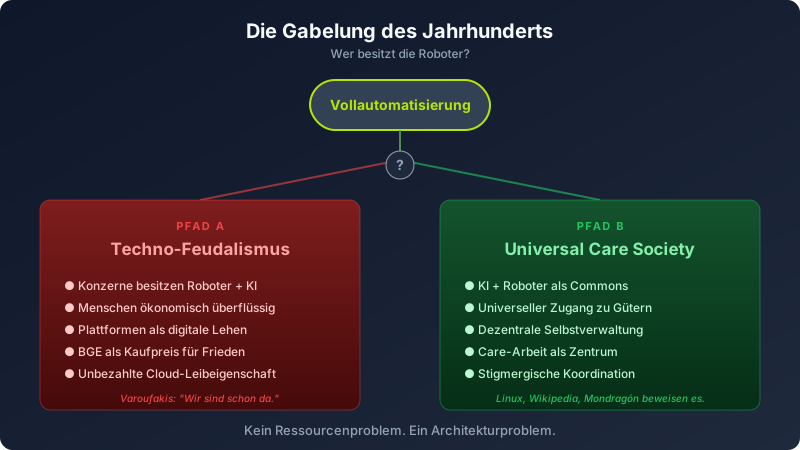
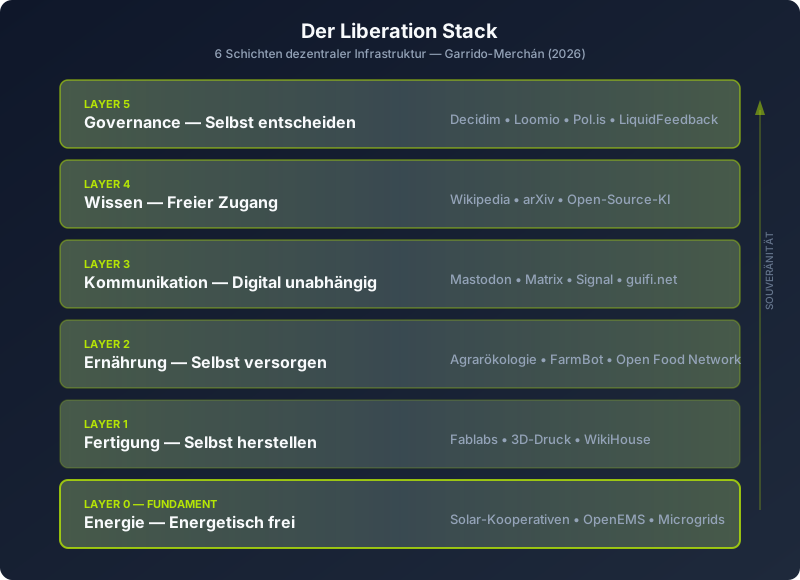
Garrido-Merchán calls this not a scarcity problem but an architecture problem. And he delivers the architecture right along with it, the Liberation Stack:
| Layer | Sovereignty | Already Exists |
|---|---|---|
| Energy | Energetically free | Solar cooperatives, microgrids |
| Manufacturing | Self-producing | Fablabs, 3D printing, WikiHouse |
| Food | Self-sustaining | FarmBot, Open Food Network |
| Communication | Digitally independent | Mastodon, Signal, guifi.net |
| Knowledge | Open access | Wikipedia, arXiv, open-source AI |
| Governance | Self-governing | Decidim, Loomio, Pol.is |
And here’s the best part: This already works. Not theoretically. Empirically.
- Linux: 33 years, 20,000+ developers. 96% of all web servers. No boss.
- Wikipedia: 25 years, 300,000+ editors. 60 million articles. No pay.
- Mondragón: 70 years, 70,000 worker-owners. €11 billion revenue. 12% more productive than conventional firms.
- Rojava: 14 years, 4 million people. Democratic confederalism. No state. Under wartime conditions.
If it works under wartime conditions, it should definitely work in your neighborhood.
Stigmergy: Coordination for the Lazy
In a world without wage labor, we need an organizational principle that works without bosses and meetings. Fortunately, there is one.
I’ve written about it: Stigmergy. Coordination through traces in the work. An ant puts down a grain of sand. The next one sees it and places its grain next to it. No meetings. No agreements. No Jira tickets. And in the end, a structure more complex than anything an architect could have designed.
It works for ants. For Wikipedia. For Linux. And it could be the foundation of a post-work society: Shared spaces, physical and digital, where the result of one action triggers the next.
Someone plants tomatoes. Another sees the plants and builds an irrigation system. A third documents the whole thing. Nobody coordinates. The work coordinates.
Sounds like a hippie fantasy? Then explain to me how 300,000 people wrote an encyclopedia without getting paid.
Kropotkin: The Man Who Knew First
Peter Kropotkin refuted Social Darwinism in 1902 with “Mutual Aid”: Not competition but cooperation is the decisive factor in evolutionary success.
Ten years later, in “Fields, Factories and Workshops,” he sketched a vision of decentralized, technologically advanced, ecologically aligned production. Not factories but workshops. Not mass production but local circular economy.
That was 1912. Nineteen twelve.
Garrido-Merchán’s Liberation Stack is Kropotkin’s vision with WiFi. Solar instead of steam. 3D printing instead of workbench. Mastodon instead of printing press. Decentralized. Cooperative. Serving people.
The old prince was right. He just had to wait 114 years for the technology.
And Now the Point Everyone Misses
Up to this point we’ve talked about systems. Economics. Technology. Governance. All important. But everyone (Gorz, Srnicek, Bastani, even Garrido-Merchán) overlooks something. Something massive. Something sitting right in front of them, staring them in the face.
Care work.

Silvia Federici described in the 1970s what Marx completely ignored: Reproductive labor. The work that produces labor power. Raising children. Caring for the elderly. Cooking meals. Doing laundry. Maintaining relationships. Being the emotional anchor. The net that holds everything together.
This work is unpaid. It appears in no statistics. It is overwhelmingly performed by women. And it is, here comes the twist, the only thing that resists automation.
A robot can assemble a car. An algorithm can review a contract. Prepare a tax notice. Write code. Write an article. Maybe even this article.
But rocking a baby to sleep? Holding a dying person’s hand? Explaining to a child why the world is sometimes unfair? Listening to a friend who doesn’t know what to do?
That requires human presence. Not as a nice-to-have. As the core. As the essence.
Care work resists efficiency gains because human attention is its material. You can’t “optimize” a conversation with a grieving person. You can’t console a child “at scale.” This isn’t a technical limitation some start-up will solve later. It’s an ontological boundary.
And Kathi Weeks provides the feminist foundation: In “The Problem with Work” (2011), she argues that we have depoliticized work. Even progressive movements (Marxism, feminism, unions) fight for better work. But they never ask the question: Why work at all?
The real liberation of labor, Weeks says, is liberation from labor.
And once you take that seriously (once you make visible the unpaid work of cooking, cleaning, child-rearing, emotional sustenance), the entire illusion of “free wage labor” collapses. Because one half of humanity never stopped working. They just never got paid for it.
The Most Radical Punchline
When AI and robotics take over all production, care work becomes the last, largest, most important domain of human activity. Raising children. Building communities. Caring for the sick. Accompanying the dying. Nurturing friendships. Resolving conflicts. Creating culture.
And here’s the punchline that keeps me up at night:
The future of human activity is what women have been doing for centuries: unpaid, invisible, and unrecognized.
Not because women are “naturally” more caring: that’s a stereotype. But because the activities that resist automation are precisely the ones our economic system has always dismissed as “not real work.”
The post-work society demands a radical revaluation: What was invisible becomes the center. What was worthless becomes the most important thing.
The political question is no longer “Who gets the job?” It’s: How do we organize care beyond market and state?
That, by the way, is also the answer to the question of meaning. Not career. Not status. Not productivity.
Care.
A Day in 2036
I don’t want to leave this abstract. Because abstract is easy to wave away. So: What might a perfectly ordinary Tuesday look like?
You wake up. No alarm. You slept until you were awake (a revolutionary idea, I know).
The food comes from the local agricultural cooperative. Automatically grown, distributed by neighbors. The energy comes from the microgrid on the roof. Communication runs through a community mesh network, not through a company selling your data.
In the morning you look after the kids in the neighborhood. Not as a job. As part of life. In the afternoon you work on an open-source irrigation system for the community farm. Not because you have to. Because it interests you.
In the evening you cook with friends. Someone brought tomatoes that grew outside. Someone else brought bread that the cooperative’s oven baked. You talk. About the kids. About the project. About philosophy. About absolutely nothing.
No money changed hands. No contract was signed. No supervisor approved anything.
And yet: Everyone got what they needed. Everyone gave what they could. Everyone did something meaningful.
Sounds utopian? Rojava works like this. Mondragón works like this. Wikipedia works like this.
Just not where you live. Not yet.
The Three Questions for the Bench
Back on the bench. Coffee still warm. Sun still there.
Three questions. No easy answers. But finally time to think about them.
1. Who owns the robots?
The fork of the century. Corporations or commons. Techno-feudalism or liberation. Garrido-Merchán calls it an architecture problem. Not a resource problem. We have enough. We just distribute it wrong.
2. What gives us meaning?
Gorz says: Multi-activity. Graeber says: Creativity. Federici says: Care. They’re all right. And all of them together may not be enough.
But that’s okay. Because the truth is: We have to relearn how to make meaning. For generations, the 40-hour work week kept us from asking this question. Now it’s in the room.
And it’s not threatening. It’s exciting.
3. How do we get there?
Srnicek and Williams bet on the state. The anarchists on parallel infrastructure. Federici on care networks. I’m betting on stigmergy: Just start. Leave traces. Trust that others will continue.
Not because that’s naive. But because that’s how Linux came into being. And Wikipedia. And every guerrilla gardening action that made a city more beautiful.
What I Do on My Bench
I’m a teacher. I automated my job. I’ve argued that my profession has no future.
And you know what? I’m fine with it.
Because now I sit on my bench and build. 12 MCP servers that democratize knowledge. Learning modules in five languages. Open-source tools anyone can use. No patent. No profit. No boss. My little Liberation Stack on a Hetzner box.
But the most important thing isn’t the code. The most important thing is what comes after. When the server runs and the automation kicks in and the bullshit work is gone.
Then what remains are the conversations. The students. The ideas. The evenings with friends. The cooking. The listening. The care.
That’s what’s left when you take the work away.
And it’s more than enough.
Come sit down. The coffee’s still warm.
Further reading for the bench:
- Garrido-Merchán: “Peaceful Anarcho-Accelerationism” (arXiv:2602.13154, 2026), The Liberation Stack
- Gorz: “Farewell to the Working Class” (1980), The Multi-Activity Society
- Graeber: “Bullshit Jobs: A Theory” (2018), Why most jobs are pointless
- Weeks: “The Problem with Work” (2011), Liberation from work
- Federici: “Caliban and the Witch” (2004), The invisible labor
- Varoufakis: “Technofeudalism” (2023), The dystopia that’s already here
- Heylighen: “Stigmergy as a Universal Coordination Mechanism” (2016), Coordination without a boss
- Kropotkin: “Mutual Aid” (1902), The man who was right
- Bélisle-Pipon: “AI, universal basic income, and power” (Frontiers in AI, 2025), When billionaires get generous
This is part of a series. Also read: Stigmergy, I’m Automating My Own Job, and The Last Teacher.
Related Articles

April 12, 2026
78% of commercial job tasks are automatable. 184 hours of development per hour of e-learning. And we only attempt things we believe we’re capable of. Three barriers that AI is blowing apart right now, and what it means for education.

February 19, 2026
A teacher who set out to digitize education reaches a radical conclusion after four years: AI makes the teaching profession obsolete.

September 7, 2026
MCP gives an AI hands. Skills give it judgement. Why only the combination is worth anything, how my setup is built from both, and ten practices that work even if you never run a single server.
Comments
Comments run on GitHub Discussions (Giscus). The script is only fetched from GitHub once you load it; your IP address is then transmitted to GitHub in the USA. Details in the privacy policy